
Fancy Serial Number Checker
A smart and reliable tool designed to analyze serial numbers, recognize special patterns, and deliver quick results.
BANKNOTE SERIAL ANALYSIS
Fancy Serial Number Checker
Discover repeating digits, ladders, radars and other collectible serial-number patterns.
Enter the digits, with an optional prefix, suffix or trailing star. US Federal Reserve note digit blocks are usually eight digits.
ANALYSIS REPORT
Your serial number
A pattern-based indicator, not a market appraisal.
Bulk serial checker
Check multiple serial numbers at once, one per line.
My saved collection
Saved privately in this browser on this device.
What Does a Fancy Serial Number Checker Actually Do?
A fancy serial number checker is an online pattern screener that reads a bill’s digits and flags memorable shapes such as solid, radar, ladder, and repeater serials, giving instant results about hobbyist interest rather than a guaranteed price.
Take 12345678: a checker recognizes it as a perfect ascending run and scores it very high, while an ordinary jumble of digits barely registers. Nothing mystical is happening; the tool compares your digits against a list of named shapes and reports which ones match.
88888888
12211221
12345678
12121212
That distinction matters before anyone gets excited. A flagged pattern tells you where to start looking, not what the bill will sell for. I treat the result as a first filter, then look at what similar notes actually fetched before deciding whether to keep, grade, or spend the bill.
What Makes a Serial Number “Fancy” in the First Place?
A fancy serial number is an eight-digit sequence on a banknote whose digits form a pattern that collectors consider uncommon, tidy, or meaningful.
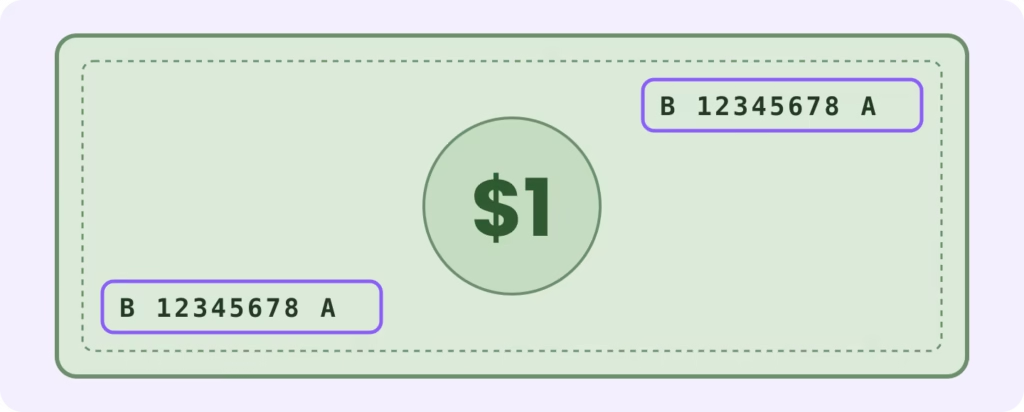
US paper money prints the serial twice, once in the upper right corner and again in the lower left corner, so locating it is easy. Most serials are random combinations; only certain sequences are prized, and the rarer the sequence, the more attention it draws.
Chasing these notes is not a recent phenomenon. People have prized them for decades, and one auction-tracking site reports that a $1 bill from 1953B with serial 00000001 sold at auction for over $10,000. Part of the draw is the thrill of the hunt: a promising serial can surface in ordinary change, which is why I glance at every bill before it goes back into circulation.
How Do You Check a Bill’s Serial Number Step by Step?
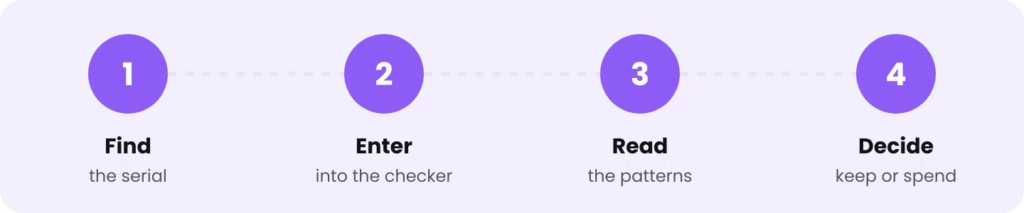
Checking a bill takes four moves: find the serial, enter it into a checker, read the patterns that come back, and decide what to do with the note. That is the quick answer, and the sequence below keeps the order straight.
1. Locate the serial, which pairs a block of digits with a prefix letter; many newer notes carry two prefix letters instead.
2. Enter the serial exactly as typed on the note into the checker’s input field on the page, for example 01010101.
3. Run the check and read the patterns reported, plus any coolness rating the tool attaches.
4. Decide whether to keep the bill, spend it, or jot keeper notes on where it came from.
Because a serial uniquely identifies one bill, a checker can compare it against known shapes without a photo. A free currency checker also removes any reason to skip ordinary-looking notes, and CoinHub’s version lets you attach extra details to each result so a find does not get lost.
Which Serial Number Patterns Do Checkers Look For?
Fancy serial number checkers look for named digit shapes, from runs of repeated digits to sets built on only two or three numerals, and each match earns an interest score.
Those scores weigh rarity against visual appeal. On one widely used scale, 90-100 marks top-tier shapes, 80-89 signals a very strong premium, and 70-79 is still worth holding onto. These sample entries show how a few shapes compare:
| Pattern | Example | Score |
|---|---|---|
| Seven of a Kind | 88888880 | 90 |
| Binary (two distinct digits) | 15511555 | 90 |
| Trinary (three digit types) | 12323121 | 70 |
| Bookend (matching first and last two digits) | 12456712 | 70 |
Prices swing widely across those tiers. The same source says a basic top-tier shape regularly sells for 500-1,000 depending on the bill, gives a market range of 500-3,000+ for its top shape, and notes that the hardest-to-find shapes can reach several thousand dollars.
What Does the Score From a Fancy Serial Number Checker Mean?
A checker’s score is a guide-level indicator of hobbyist interest, not a quote of what the bill will sell for.
The tool attaches pattern names so you can see why a number earned its score. The mirrored 12211221 is a palindrome that also repeats, which makes it a radar repeater scoring 95, while a true binary serial built only from 0 and 1 reaches 98. A quad double layout also scores 95, and four pairs lands at 90.
Position works on a separate track. A super low serial such as 00000007 scores 99, and a high serial from the last thousand numbers printed scores 90. At the bottom, anything under 70 is flagged as limited interest, and the scale itself advises spending it as a plain note at face value unless it carries personal meaning.

Does a Fancy Pattern Automatically Make a Bill Valuable?
No: a fancy pattern raises interest in a bill, but its price rests on several other factors that the table below lays out.
| Factor | Why it matters |
|---|---|
| Condition | A pristine note outdraws a worn one carrying the same digits. |
| Denomination | A higher-value bill with the same pattern usually earns more, because its base value is higher. |
| Series | Buyers favor particular issues, so identical digits can sell differently across years. |
| Print run | The number of notes printed shapes how hard a given bill is to find, which feeds scarcity. |
| Market demand | What buyers are actually paying at the moment of sale decides the final price. |
Position and near-misses follow the same logic. A low serial number under 100 can earn a premium, and a near perfect version of a top pattern typically sells for about 60-75% of what its perfect counterpart would command.
Star notes call for the same caution. A star reflects a replacement numbering process, yet how hard that bill is to find still depends on the factors above.
How Do Star Notes Fit Into Fancy Serial Number Checking?
A star note is a replacement bill that carries a star in place of the usual closing letter on its serial, and checkers treat that star as context alongside the digit pattern.
The Bureau of Engraving and Printing explains that older Federal Reserve notes commonly used a letter, the digit block, and a suffix letter. A star symbol can stand in for that final letter when a replacement sheet is used, which is why a checker keeps the star in view even while it scores only the digits.
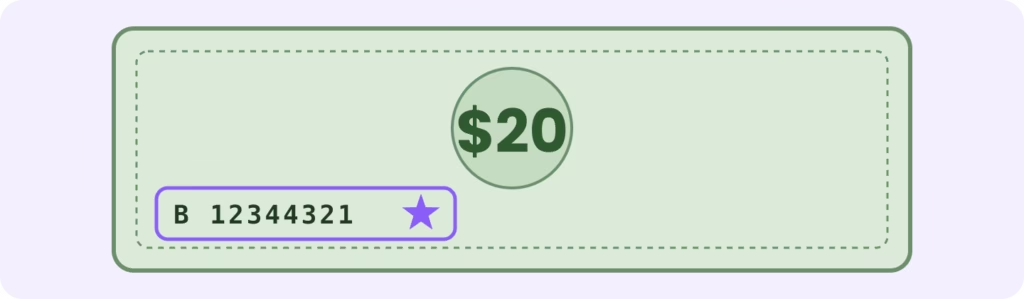
Tools that auto-detect the star record its replacement status separately from the pattern, so a mirrored serial on a $20 star note shows up as two distinct findings. A star alone does not establish a premium, though; print volume, physical state, and buyer interest still decide the outcome, and comparing sold examples is the only way to set realistic price expectations.
What Can and Can’t a Fancy Serial Number Checker Do?
A fancy serial number checker classifies digit patterns and flags star status, but it is a screening aid, never an appraisal.
Within that scope the tools differ. The one from Direct Tools Pro places no limits on how many serials you check, another normalizes the entry by stripping stray spaces and symbols, and a third recognizes mirrored sequences such as 12344321. One site also flags birthday-style serials, and Softonic’s version reports star-note status so the star is not lost.
Some sites pair the checker with a tracker that stores your finds, and a signed-in account syncs those entries. Market-data tools add filters, including a Premium (EPQ) option, to narrow sold listings.
What none of them will do is predict a sale price or confirm that a bill is genuine, and questions about star-note production belong to dedicated lookup tools instead.
Which Fancy Serial Number Myths Should You Ignore?
The most persistent fancy serial number myths are that only uncirculated bills matter, that every star-marked note is a jackpot, and that the hobby is brand new.
On the first, physical state helps but does not decide everything: a worn one-dollar bill with serial 88888888 could still be worth $300-500 to the right buyer. On the second, a ★ after the serial marks a replacement bill, and star notes appear in smaller quantities, yet only those with a tiny run size or a fancy serial command significant premiums.
The third myth ignores history. Hobbyists known as notaphilists saw interest go mainstream in the 1960s and 1970s, and the internet simply made trading easier. Today collector forums connect buyers with sellers, which is one more reason to compare several sold examples before trusting any single price.
How Much Is My Fancy Serial Number Bill Actually Worth?
A fancy serial number bill is worth anywhere from a slight premium to a four-figure sum, depending on how strong the pattern is, how worn the note is, and who is buying.
Checkers turn that uncertainty into a number. The SerialWorth tool reports a value score from 0-100, and Softonic’s checker sorts serials into an interest tier instead. Neither replaces judgment: 00012345 looks tempting because of its leading zeros, yet it is worth less than a perfect ascending run.
For a real benchmark, lean on completed sales and ignore inflated asking prices. Researching results from currency auctions and listings on online marketplaces such as Etsy shows what buyers actually paid, and heavy wear can pull that number down. A checker also cannot confirm authenticity, so settle that question separately before money changes hands.
What Makes a Serial Number “Fancy” in the First Place?
A fancy serial number is an eight-digit sequence on a banknote whose digits form a pattern that collectors consider uncommon, tidy, or meaningful.
US paper money prints the serial twice, once in the upper right corner and again in the lower left corner, so locating it is easy. Most serials are random combinations; only certain sequences are prized, and the rarer the sequence, the more attention it draws.
Chasing these notes is not a recent phenomenon. People have prized them for decades, and one auction-tracking site reports that a $1 bill from 1953B with serial 00000001 sold at auction for over $10,000. Part of the draw is the thrill of the hunt: a promising serial can surface in ordinary change, which is why I glance at every bill before it goes back into circulation.
How Do You Check a Bill’s Serial Number Step by Step?
Checking a bill takes four moves: find the serial, enter it into a checker, read the patterns that come back, and decide what to do with the note. That is the quick answer, and the sequence below keeps the order straight.
1. Locate the serial, which pairs a block of digits with a prefix letter; many newer notes carry two prefix letters instead.
2. Enter the serial exactly as typed on the note into the checker’s input field on the page, for example 01010101.
3. Run the check and read the patterns reported, plus any coolness rating the tool attaches.
4. Decide whether to keep the bill, spend it, or jot keeper notes on where it came from.
Because a serial uniquely identifies one bill, a checker can compare it against known shapes without a photo. A free currency checker also removes any reason to skip ordinary-looking notes, and CoinHub’s version lets you attach extra details to each result so a find does not get lost.
Which Serial Number Patterns Do Checkers Look For?
Fancy serial number checkers look for named digit shapes, from runs of repeated digits to sets built on only two or three numerals, and each match earns an interest score.
Those scores weigh rarity against visual appeal. On one widely used scale, 90-100 marks top-tier shapes, 80-89 signals a very strong premium, and 70-79 is still worth holding onto. These sample entries show how a few shapes compare:
| Pattern | Example | Score |
|---|---|---|
| Seven of a Kind | 88888880 | 90 |
| Binary (two distinct digits) | 15511555 | 90 |
| Trinary (three digit types) | 12323121 | 70 |
| Bookend (matching first and last two digits) | 12456712 | 70 |
Prices swing widely across those tiers. The same source says a basic top-tier shape regularly sells for 500-1,000 depending on the bill, gives a market range of 500-3,000+ for its top shape, and notes that the hardest-to-find shapes can reach several thousand dollars.
What Does the Score From a Fancy Serial Number Checker Mean?
A checker’s score is a guide-level indicator of hobbyist interest, not a quote of what the bill will sell for.
The tool attaches pattern names so you can see why a number earned its score. The mirrored 12211221 is a palindrome that also repeats, which makes it a radar repeater scoring 95, while a true binary serial built only from 0 and 1 reaches 98. A quad double layout also scores 95, and four pairs lands at 90.
Position works on a separate track. A super low serial such as 00000007 scores 99, and a high serial from the last thousand numbers printed scores 90. At the bottom, anything under 70 is flagged as limited interest, and the scale itself advises spending it as a plain note at face value unless it carries personal meaning.
Does a Fancy Pattern Automatically Make a Bill Valuable?
No: a fancy pattern raises interest in a bill, but its price rests on several other factors that the table below lays out.
| Factor | Why it matters |
|---|---|
| Condition | A pristine note outdraws a worn one carrying the same digits. |
| Denomination | A higher-value bill with the same pattern usually earns more, because its base value is higher. |
| Series | Buyers favor particular issues, so identical digits can sell differently across years. |
| Print run | The number of notes printed shapes how hard a given bill is to find, which feeds scarcity. |
| Market demand | What buyers are actually paying at the moment of sale decides the final price. |
Position and near-misses follow the same logic. A low serial number under 100 can earn a premium, and a near perfect version of a top pattern typically sells for about 60-75% of what its perfect counterpart would command.
Star notes call for the same caution. A star reflects a replacement numbering process, yet how hard that bill is to find still depends on the factors above.
How Do Star Notes Fit Into Fancy Serial Number Checking?
A star note is a replacement bill that carries a star in place of the usual closing letter on its serial, and checkers treat that star as context alongside the digit pattern.
The Bureau of Engraving and Printing explains that older Federal Reserve notes commonly used a letter, the digit block, and a suffix letter. A star symbol can stand in for that final letter when a replacement sheet is used, which is why a checker keeps the star in view even while it scores only the digits.
Tools that auto-detect the star record its replacement status separately from the pattern, so a mirrored serial on a $20 star note shows up as two distinct findings. A star alone does not establish a premium, though; print volume, physical state, and buyer interest still decide the outcome, and comparing sold examples is the only way to set realistic price expectations.
What Can and Can’t a Fancy Serial Number Checker Do?
A fancy serial number checker classifies digit patterns and flags star status, but it is a screening aid, never an appraisal.
Within that scope the tools differ. The one from Direct Tools Pro places no limits on how many serials you check, another normalizes the entry by stripping stray spaces and symbols, and a third recognizes mirrored sequences such as 12344321. One site also flags birthday-style serials, and Softonic’s version reports star-note status so the star is not lost.
Some sites pair the checker with a tracker that stores your finds, and a signed-in account syncs those entries. Market-data tools add filters, including a Premium (EPQ) option, to narrow sold listings.
What none of them will do is predict a sale price or confirm that a bill is genuine, and questions about star-note production belong to dedicated lookup tools instead.
Which Fancy Serial Number Myths Should You Ignore?
The most persistent fancy serial number myths are that only uncirculated bills matter, that every star-marked note is a jackpot, and that the hobby is brand new.
On the first, physical state helps but does not decide everything: a worn one-dollar bill with serial 88888888 could still be worth $300-500 to the right buyer. On the second, a ★ after the serial marks a replacement bill, and star notes appear in smaller quantities, yet only those with a tiny run size or a fancy serial command significant premiums.
The third myth ignores history. Hobbyists known as notaphilists saw interest go mainstream in the 1960s and 1970s, and the internet simply made trading easier. Today collector forums connect buyers with sellers, which is one more reason to compare several sold examples before trusting any single price.
How Much Is My Fancy Serial Number Bill Actually Worth?
A fancy serial number bill is worth anywhere from a slight premium to a four-figure sum, depending on how strong the pattern is, how worn the note is, and who is buying.
Checkers turn that uncertainty into a number. The SerialWorth tool reports a value score from 0-100, and Softonic’s checker sorts serials into an interest tier instead. Neither replaces judgment: 00012345 looks tempting because of its leading zeros, yet it is worth less than a perfect ascending run.
For a real benchmark, lean on completed sales and ignore inflated asking prices. Researching results from currency auctions and listings on online marketplaces such as Etsy shows what buyers actually paid, and heavy wear can pull that number down. A checker also cannot confirm authenticity, so settle that question separately before money changes hands.
Is the Fancy Serial Number Checker Free to Use?
Yes, the fancy serial number checkers reviewed here are free to use, and they ask for no signup before you start.
A typical check finishes in about ten seconds: enter the serial, press the analyze button, and read what comes back. The tool needs no file and no image upload, and it works for bills from $2 to the top of the range, including $5 and $10 notes. Star notes, which are replacement notes, can be checked the same way.
Cost only enters the picture afterward. If a result looks exceptional, professional grading is the next step the source recommends, and that is a separate service from the checker itself.
Is Anything Uploaded When I Check a Serial Number?
No, nothing needs to be sent: the checker works only from the serial entered into its input field, with no download required.
It reads the numeric digits and returns whatever it finds. In one site’s examples, 43851907 comes back as No Pattern with a score of 60, while 12323122 earns 70. The prefix, suffix, and any star are still shown alongside the result because they help when you look up the note’s details later.
Saving is where privacy details change. A private vault feature can keep your entries in the browser as local records, so clearing browser data can wipe them out, while syncing to the cloud needs registration and a sign-in.
Where Can I Sell a Bill With a Fancy Serial Number?
Sellers can reach buyers through eBay, through Heritage Auctions, or through dedicated hobby communities, and the right route depends on how strong the serial is.
Preparation is worth doing before any listing goes up. An Excel-ready CSV export from an organizing tool turns scattered finds into a spreadsheet that doubles as an inventory and an insurance record.
When you list, accurately describe the bill and name its series/year, since buyers can filter on both. A sold-price lookup such as an Auction History Search shows what similar serials actually fetched. Low-value notes carry a lower cost of entry and are the most commonly collected, yet the standard expert advice still applies: show patience, since waiting tends to beat taking the first offer.
Are Circulated Bills With Fancy Serial Numbers Still Valuable?
Yes, circulated bills with fancy serial numbers can still be valuable, because an extraordinary pattern can outweigh signs of use.
Crisp, gem-quality notes earn the top prices, but a used bill with a strong pattern keeps real value. Weaker patterns draw only a small premium, while the strongest can reach hundreds of dollars, so a bill pulled from a wallet deserves a check before it is spent.
Run the serial through the checker and note the collector value score; if it is high, save the details somewhere you can find them again. Currency dealers may buy interesting bills, though typically at wholesale prices, which is worth weighing against selling directly. Describe the bill’s physical state honestly whichever route you choose.
Which Bills Can Carry Fancy Serial Numbers?
Every current US bill, from one-dollar notes up to the top of the range, carries a serial with 8 digits, so any of them can form a fancy pattern.
One- and two-dollar notes are the most commonly collected, which is exactly why fives, tens, and twenties get checked less often. That neglect can make a fancy pattern in circulation slightly more likely to slip by, even in change handed back across a cash register counter.
The $50 and $100 notes command the highest premiums for a given pattern, though they cost more to collect. The same sequence on a bigger bill brings more mainly because the bill itself starts out worth more.
Why Does the Checker Ignore the Prefix and Suffix?
The checker ignores the prefix and suffix for most patterns because nearly every pattern name is defined by the digit block, so the letters are kept only as context.
Entry formats such as A12345678B and AB12345678C show how this works: the tool strips punctuation and spaces, then compares the digits alone. A serial like 12121212 earns its score from the digits, whatever letters surround it, and only the characters you enter are examined.
The letters still matter for the note itself. They help pin down the issuing district, and a star in the final position marks a bill that replaced an imperfect sheet found during production, a stand-in for a defective one. That is why the checker displays the prefix, suffix, and star rather than scoring them.